Showing posts with label Emblematic buildings. Show all posts

What to see in Canfranc Station (Pyrenees, Huesca)


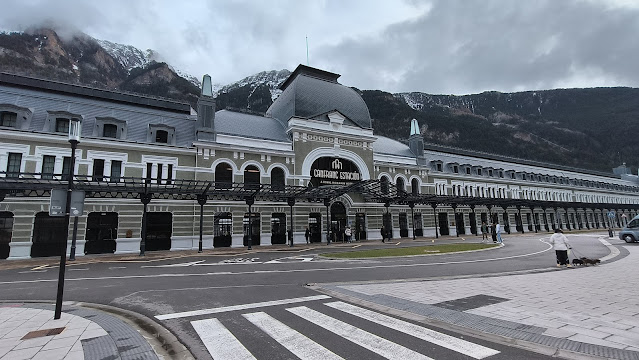
Canfranc railway station (Estación de tren de Canfranc Canfranc-Estación) is a historic building located in the Aragonese Pyrenees (Huesca, Aragón), on the border between Spain and France. It is made up of a complex of buildings that are unique both for their elegant appearance and their history. 

This station played an important role in the first half of the 20th century as a railway station connecting Aragon with France, especially during the Spanish Civil War and World War II. 

The town of Canfranc (and Canfranc-Estación) is located north of Jaca, on the border with France. It is usually visited by car, but can also be visited by train, stopping at the new railway station.


Canfranc International Railway Station (historic building) and its surroundings

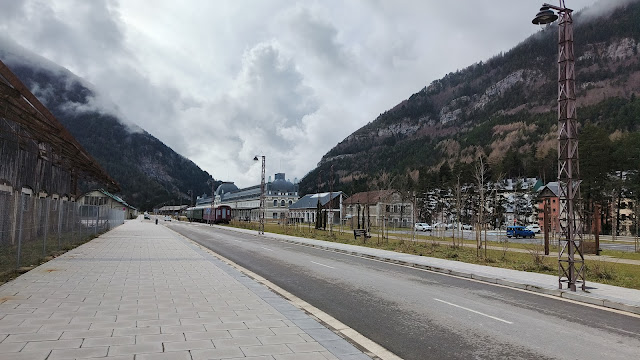
The main historical building of the railway station was built in 1915-25 and closed in 1945-49, remaining almost abandoned for many years, but being highly popular and remembered for its history and architectural beauty. Around the building you can see the railway tracks, 20th century railway machinery (cranes, etc.), warehouses and goods transfer areas.

The beauty of the site lies not only in the uniqueness of the building in the middle of the mountains, but also in the landscape and nature surrounding the ensemble of buildings and open areas.

Today the main building of the station is restored and transformed into a luxury hotel. The restoration of the area was done between 2017 and 2023. Today the area can be visited, being a well-remembered part of the history of the trains and the recent history of Aragon (see more information here).

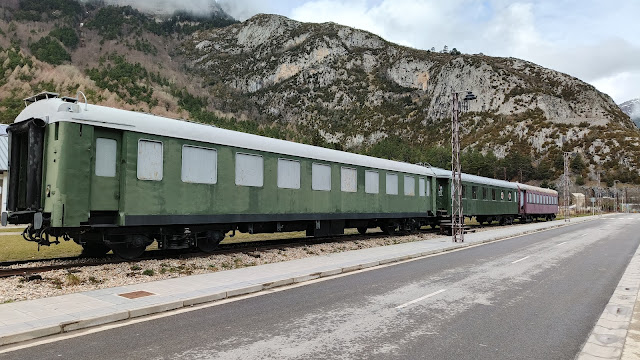
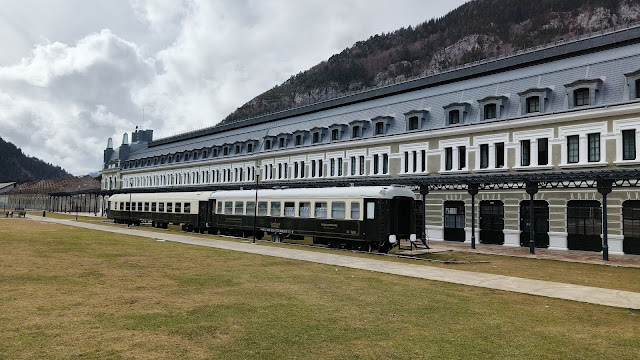
The area has a garden-museum (Jardín Ferroviario) in the surrounding area where you can see old train carriages and machinery of the time. There are also walking routes nearby where you can go on nature excursions.


Photos of the historic station (now a hotel):


Gardens, wagons, train tracks and old machinery (Railway Garden / Jardín Ferroviario):


Franco-Aragonese cuisine restaurant car:


Photos of the interior of the hotel:


Walking routes in the surrounding area:


Canfranc town, Somport Tunnel and the new railway station

Canfranc (urban centre) is located next to the station. The town is divided into two population nuclei: Canfranc village and Canfranc Station, both very close to each other.

Canfranc is a small town well known, apart from the railway station, for being next to the French border, as well as for the ski resorts in the area and for its nature. It is a small town but very popular with tourists, with hotels, restaurants and shops. 

The new train station, currently open, is located just behind the historic building of the old station. Also, next to the area is the Somport Tunnel. This tunnel connects this area of the Pyrenees with France by road. It is 8.6 km long and the current tunnel was opened in 2003.

New train station:


Signs: Map of Canfranc International Station, Explanada de los Arañones, photos and history of the place.

Photo: Inauguration of the International Station. 18 July 1928.


Other nearby places to visit

Nearby places: Jaca, Villanúa, Sabiñánigo, Huesca.

Ski resorts: The nearest ski stations are Astún and Candanchú.

Santo Estevo Parador Hotel: An old monastery to sleep surrounded by nature in the Ribeira Sacra (Galicia)

The Parador of Santo Estevo (Galicia) has been recognised as one of the most beautiful Paradors in Spain. This former monastery is now a hotel where you can stay and disconnect from the world, in the Ribeira Sacra of Galicia.

This parador was a Benedictine monastery that dates back to the 10th century and was extended in the following centuries. It has a total of three cloisters that can be visited, one Romanesque, one Gothic and one Renaissance.

Both for its beautiful architecture and its state of preservation, as well as for the nature that surrounds it, if you want to visit the interior of Galicia and are looking for a quiet and inspiring place to spend a few days, the Parador de Santo Estevo is an option that you should take into account.


Tips for staying at the Parador and visiting the surrounding area

Spain's Paradors are unique buildings that for various reasons have been converted into hotels, allowing these historic sites to be preserved in good condition and giving visitors the opportunity to enter and spend a few days in these impressive buildings. 

Among the diversity of existing Paradors (see https://paradores.es ), the Parador de Santo Estevo (Monasterio de Santo Estevo de Ribas de Sil) is one of the most beautiful and emblematic. The place was recently restored and reopened as a parador, converting the monks' cells into hotel rooms (77 rooms) and converting some of its rooms into the restaurant and other services of the parador, but at the same time preserving its exterior architecture as well as many of its emblematic rooms, cloisters, corridors and staircases.

The parador is located in the canyon of the Sil River, in the province of Ourense, 25 km from Ourense city. It is located in the middle of the mountainous nature, surrounded by forest in a small village of no more than 20 houses. The usual way to get there is by car (there is a car park at the entrance), however the access route is complicated and often the GPS does not recognise the roads well.

The parador has rooms with views of both the interior and the surrounding forest. Guests can visit the inside of the building and see the various rooms and halls where the monks lived (cloisters, kitchens, living rooms, monks' cells -now converted into hotel rooms-, an old oven-bakery in an area near the monastery, etc.). Guided tours of the interior, including dramatised visits, are also scheduled.

The place has a restaurant and cafeteria, and we recommend you try the restaurant's menu with traditional Galician food from the area. It also has a spa/jacuzzi area.

Around the building there are several excursions by foot of different levels of difficulty and length. Among them there is a circular path down from the mountain to the river, which starts and ends at the door of the parador.

If you are goint to stay several days at the parador you can visit the nearby villages, as well as other places and nature within the Ribeira Sacra.


Other nearby places to visit in Galicia

- Ourense: A curious place to visit in Ourense are its natural spas (termas, natural hot springs). There are several of them in the city and surroundings.

- Vigo: Among the places to see near Vigo, we recommend visiting the island of La Toja (Illa da Toxa), and take a boat ride in the surroundings (Boat of the mussels).

- Other places to visit are Santiago de Compostela, A Coruña, or the famous Playa de las Catedrales.

Visit to the Geominero Museum in Madrid / Museo Geominero (Madrid)

The Geominero Museum (Museo geominero) in Madrid is a place that, at first glance, from the street, may go unnoticed (or you may not even realise it exists) but once inside it hides an unexpected treasure, both for its contents and for the architecture of the building.


Inside the Geominero Museum (Museo geominero)

The Geominero Museum is located next to the Rios Rosas metro station. It is located in the building of the Geological and Mining Institute of Spain - Instituto Geológico y Minero de España (Calle de Rios Rosas, 28), and admission to the museum is free.

The museum's large main hall has a huge glass ceiling, a ground floor full of display cases and three upper floors with perimeter balconies overlooking the ground floor, which are reached by old stairs and are full of shelves and display cases with exhibitions.  

The museum experience is surprising not only for its content (a large exhibition of minerals, fossils, rocks, etc. from Spain and the rest of the world), but also for the ambience of total calm and tranquillity, and for the atmosphere of the building, which evokes a journey into the past. It is not for nothing that the IGME celebrated its 175th anniversary in 2024, and the building was constructed between 1921 and 1940. The collections on display are more than a century old. 

The duration of the visit can range from 1 hour to 3 or 4 hours, depending on the person and their interest in geology and mining. Moreover, the museum is quite close to the Natural Science Museum, another well-known and very extensive museum in Madrid, so you can walk from one to the other and in one day you can visit both.

More information about the museum (opening hours, history, etc.) can be found at https://www.igme.es/museo


Other nearby museums in Madrid 

- Natural Science Museum (Museo de ciencias naturales), located on Paseo de la Casetallana, next to the roundabout at the Fuente de San Juan de la Cruz (Gregorio Marañón metro station, near Nuevos Ministerios).

- Sorolla Museum.

- Madrid museum triangle: Prado Museum, Reina Sofía Museum and Thyssen-Bornemisza Museum.

- Museo de América, in Ciudad Universitaria (near Moncloa metro station).

The Moncloa Lighthouse (Madrid)

The Moncloa Lighthouse (Faro de Moncloa) is a 110-metre-high viewpoint tower located at the entrance to the University City of Madrid, in the District of Moncloa.

The lighthouse can be reached on foot in about 5 minutes from the exit of the Moncloa Metro Station along a pedestrian walkway.

The entrance to the lighthouse costs about 4€, and once inside you will take the panoramic lift to the top floor. From there you can enjoy a privileged 360º view of the whole city of Madrid and its surroundings. The visit lasts about 30 minutes.

Next to the Moncloa Lighthouse is the Museum of America (Museo de América), as well as other unique buildings in the University City that can also be visited. Also nearby is the Parque del Oeste, from where you can walk to the Madrid Cable Car, the Temple of Debod or Plaza España.


History of the Moncloa Lighthouse and views from the viewing point

This unique building was built in 1992 as a lighting tower. During its history, the tower has gone through different phases, having been closed to the public for some years. Nowadays, the tower is open to anyone who wants to visit it as a viewpoint.

From the viewpoint on the top floor you can see the whole city of Madrid, and from the place itself it points out and explains where the main buildings of the city are, for example, the main skyscrapers of La Castellana, the buildings of Plaza España, the Royal Palace, the Casa de Campo, the Parque del Oeste, the Palacio de la Moncloa, etc. as well as the surrounding areas (mountains, places of interest, etc.). Therefore, this is a good place for both tourists and residents who want to have an overview of Madrid from the sky.

Below you can see some pictures of the viewpoint from the inside:


Other touristic places of Madrid, near the Moncloa Lighthouse

- Plaza de España: In Madrid's Plaza España you can see the first skyscrapers built in Spain. It is only 4 minutes away from the Temple of Debod.

- Gran Vía: Gran Vía is one of the most famous avenues in the Spanish capital. This street connects Plaza de España with other areas such as Cibeles, Sol and the neighbourhoods of Malasaña and Chueca.

- The Royal Palace (Palacio Real): The Royal Palace is the official residence of the King of Spain Juan Carlos I, who uses it to organise important events, as the king actually lives in La Zarzuela. The palace was built between 1738 and 1755, and King Felipe V (1683-1746) ordered its construction.  The Royal Palace is a 6-minute walk from the Temple of Debod.

Monastery of Veruela, Vera de Moncayo (Aragón)

Founded in 1145 by Don Pedro Atarés, Señor de Borja, the Monastery of Veruela (Royal Monastery of Santa María de Veruela – Monasterio de Veruela) was the very first cistercian Monastery established in La Corona de Aragón (Crown of Aragón). In fact, the cistercian monks moved here in 1171 and the consecration of the abbey was in 1248 by the bishop of Calahorra.

The emblematic Royal Monastery of Santa María de Veruela is located in an outstanding quiet valley at the foot of the spectacular Moncayo Mountain, very close to the Huecha River, and 1 km away from the lovely Vera de Moncayo village, in the western Zaragoza province.

Veruela’s Monastery was certainly built as many cistercian abbeys, a standard layout or a typical design of the cistencian order was repeated with its abbey church beside the cloister and the rooms spread around the cloister. Besides, a vegetable garden and gardens and other buildings such as the mill and the water tank ( aljibe) were separated from the main buildings.

The medieval complex of the Monastery of Veruela was built between 12th and 14th centuries in Romanesque and Gothic architectural styles. Moreover, the Renaissance palace of the abbot and other buildings were built in the 16th century, and a new Baroque monastery was also added next to the medieval cloister in the 17th century, as well as a fortified hexagonal wall, which has remaind intact since 16th century, had been erected around all the buildings and its grounds in the 16th century occupying an area of more than 50,000 square metres.


What to see in Veruela’s Monastery

A fortified tower built in the 13th century in Romanesque style gives visitors a cozy welcome before going into the walled Monastery.

If tourists decide to visit the monastery by themselves, they should not miss the chance to see the breathtaking Church of Santa María de Veruela, which impresses visitors with its measurements of more than 72 meters long by more than 22 meters wide and more than 18 meters high. Being the most remarkable building of the Monastery, the church has three naves and Latin cross plan in Romanesque and Gothic styles dating from the12th and 13th centuries. Its main facade from the12th century in Romanesque style with fine capitals on its portade (gate) shows us the beauty and simplicity of the cistercian architecture. Inside visitors can see: several Romanesque chapels from 12th century; the Virgin of Veruela, a statue of wood carving of Our Lady of Veruela from the 15th century; on the left there are the chapel dedicated to San Bernardo with the beautiful sepulcher of the abbot Lope Marco dating in the mid 16th century and a medieval spiral staircase that goes up to the San Martin’s bell tower dating from the 13th century; on the right, there are the Baroque gate of the sacristy from the 16th century; the magnificent monks door from 13th century that allows visitors to go into the cloister and admired the three sepulchers dating from 12th century on their left; and the converts door that goes into the cilla (storeroom) and the cloister.

The spectacular medieval cloister from the 14th century in Gothic style is the heart of the monastery, from here visitors can easily go into the most important rooms of the medieval monastery even the church. In the 16th century, a Renaissance double cloister was added over the medieval cloister.

The new sacristy lies among the church, the cloister and the chapter room, here visitors can know more about the beautiful main altarpiece of the church and enjoy the interesting paintings, sculptures, remains of the main altarpiece among other things.

The remarkable chapter room is dated in the 13th century in Romanesque style, here visitors can admire the sepulcher of Lope Ximenez from 13th century and the abbot Sancho Marcilla from 14th century.

The monks room from 13th century in Romanesque style is also worth a visit, as well as the Refectory dating in the13th and 16th centuries in Romanesque and Gothic style that is used for exhibitions.

People should not leave the monastery without visiting: lavatorium, storeroom (cilla), kitchen, warming room, dormitory, new monastery, as well as the mill and the Wine Museum which is situated in the aljibe (water tank).

This beautiful monastery is also renowned because the poet Gustavo Adolfo Béquec and his brother Valeriano stayed here between November 1863 and October 1864 so that Gustavo got over his serious disease. The poet wrote the famous “Letters from my cell” during his stay in the monastery.

If tourists are interested in knowing more about this historic monastery, they are allowed to wander around the monastery. Moreover they might come across interesting artwork. By the way, the cistercian monks left this abbey in 1835; after that, in the mid 19th century it become a hotel where a lot of tourists spent their summers. Besides, the Jesuit monks stayed in this monastery nearly one century; and finally, in 1998 the property of the monastery passed to La Diputación de Zaragoza (Country Counsil). which maintains it in excellent state of preservation.

People enjoy visiting Verula’s Monastery and its outanding natural landscape, imagining themselves for some moments back in the medieval period, it can be a unique experience.

It is 75 km away from Zaragoza, 12 km from Tarazona and 15 km from Borja.


More places to visit in Aragon

What to see in Zaragoza city: With almost 700,000 inhabitants, Zaragoza (Saragossa) is one of the biggest cities of Spain. Its strategical location between Madrid, Barcelona, Valencia and Bilbao, and its proximity to The Pyrenees and France, make Zaragoza one of the most important logistic points of Spain.

– Tarazona: Tarazona is situated in the Queiles valley at the foot of the majestic Moncayo massif, in an outstanding natural landscape of exceptional beauty in the western Aragón.

Huesca and The Pyrenees / Los Pirineos.

Teruel: Located in the south of Aragón, Teruel city is an ideal city to live and enjoy its interesting museums, unique architecture, traditional festivals, delicious gastronomy, among other things.

Cadiz City: What to visit in Cadiz (Andalusia)

Situated on a small peninsula in the Andalusia region, on the southwest Spanish coast, Cádiz is bordered by the Atlantic Ocean and joined to the Iberian Peninsula (San Fernando town) by a long narrow isthmus. Its ideal geographical location, its mild, warm and sunny weather almost all year round, and its well preserved cultural and historical heritage make Cádiz an attractive tourist destination.


Cádiz is the oldest city in Spain, was founded 3,100 years ago by the Phoenicians (Fenicios) who named it Gadir and in the 3th century the Romans called it Gades, therefore, people who are born in Cádiz are called Gaditanos. Besides, when Phoenicians, Greeks, Romans, Visigoths and Muslims inhabited here they left an unmistakable cultural imprint on Cádiz which was conquered by the King of Castilla Alfonso X El Sabio ( 1221-1284) in 1262.

Nowadays, Cádiz and the Iberian Peninsula are linked by the isthmus, the Carranza Bridge, which was built between 1960 and 1970 of 1400 meters long, and the Puente de la Constitución de 1812 (Bridge of the Constitution of 1812) also called La Pepa Bridge that was built between 2007 and 2014. Being the longest bridge in Spain (1,655 meters in length over the sea), La Pepa Bridge was designed by the world renowned engineer Javier Manterola who was born in 1936 in Pamplona. It is said that the Drawbridge of the Constitution of 1812 is going to be the most emblematic construction of Cádiz. Both the Carranza and La Pepa bridges cross over the Bay of Cádiz from Puerto Real town to Cádiz.

Cádiz, with a population of about 135,000, has a lot of to offer in the way of architecture, culture, gastronomy, entertainment, carnivals, flamenco, beaches, nightlife among others without forgetting its important seaport.


What to visit in Cádiz city

Firstly, we suggest taking a leisurely walk through its historical walled town (casco antiguo), enjoying its narrow streets, alleys and typical squares sensing the friendly atmosphere of the neighborhoods which still retain a lot of its traditional charm. Moreover, local people really have a lot of fun and open mind.

The Cathedral Square, one the most popular places in Cádiz, is in the medieval Pópulo quarter, which is really the oldest part of the city, visitors will be able to find the most remarkable buildings of Cádiz, such as the imposing Cathedral also known as New Cathedral in Baroque and neoclassical style that was built between 18th and 19th centuries and designed by Vicente Acero. Here is the tomb the world renowned musician Manuel de Falla. Besides, if visitors go up the Poniente Tower they will be able to enjoy a breathtaking view of the golden dome, the city and surroundings. It is worth a visit.

Following the walk from Cathedral Square people can go under the Arco de la Rosa (Rose Arch) from 13th century, it was a gateway to the walled town built by Alfonso X (1221-1284). This Pasaje de la Rosa ( Rose Passage) goes to San Martín Square, here are the Casa del Almirante with facade from 17th century in Baroque style, and the Church of the Carmen dating from 18th century in Baroque style inside a fine altarpiece from 18th century. If visitors take the Obispo Rances Street, they will arrive at The Fray Félix Square one of the most interesting spot.

Santa Cruz Church, (also known as the Old Cathedral) was finished its construction in the early 17th century by Cristobal de Rojas in Renaissance style. Being the first Cathedral of Cádiz until 1838, Santa Cruz Church was built on the site of a previous church destroyed in the late 16th century, which had been built on the site of a mosque. Inside Santa Cruz Church its main altarpiece, the Genoveses Chapel and the Urn and the Christ of Holy are worthy of mention. The Sagrario Tower and the Cathedral Museum next to Santa Cruz Church are also must see places.

Casa del Obispo ( Bishop’s Palace) between the New Cathedral and the Fray Felix Square ( Santa Cruz Church ) is the most important archaeological remains of the city ( Phoenicians, Romans and medievals) can still been seen in this palace.

Teatro Romano (the Roman Theater) was built in the late first century before of Christ being the largest Roman Theater in Spain. It was discovered in 1980 by chance. It is next to Santa Cruz Church too.

Other interesting places in this quarter of Pópulo are: The Arco del Pópulo (Pópulo Arch) from 13th century was other gateway of the walled city built by Alfonso X (in Fabio Rufino Street). Arco de los Blancos (White Arch) of four Arches was part of a medieval castle and other gateway from 13th century. It is in San Juan de Dios Street next to the Roman Theater .

If tourists visit the Pópulo neighborhood they will be able to enjoy its shops, cafés, taverns, traditional dishes, delicious tapas and wines spending their free time sitting in its open air terraces because the weather in Cádiz is usually excellent.

By the way, the promenade goes around the old town so the Cathedral, Casa del Obispo, Santa Cruz Church, Roman Theater and other places can also be reached by Campo del Sur Avenue (Paseo Maritimo).

It is said that flamenco song was born of the people of Santa María neighborhood, so the music roots come alive in its streets. If people want to know more about flamenco, they will probably have a first contact with Flamenco in this neighborhood.

Puertas de Tierras one of the most emblematic monument of Cádiz separates the Old walled Town from the modern Cádiz city.

The Town Hall building, which was built in the early 19th century in neoclassical style, has a beautiful facade and is located in the lively San Juan de Dios Square one meeting point in the heart of Cádiz.

Museo del Vinos y Toros de Cádiz (Wines and Bulls Museum) is an exhibition about wines and bulls in where visitors can taste the delicious wine from Cádiz and know more about the traditional bullfights ( a spectacle in which a man fights and kill a bull).

In middle of the Spain Square people can find the magnificent Monument to the Constitution of 1812 which was raised in 1912, and other interesting buildings such as the Customs and the House of the Four Towers. Do not miss out on the port and pier on the Cádiz Bay nearby.

Oratorio de la Santa Cueva, which consists in two outstanding chapels, is considered to be a masterpiece of the neoclassical Gaditano, decorating with paintings by Francisco de Goya, Zacarias Gónzalez and others world renowned arts.

People interested in art should visit the Cádiz Museum where they not only will find paintings by Zurbarán, Murillo, Rubens, Alonso Cano among others but also archaeology, art and history. Is is in La Mina Square.

Alameda Apodaca is a popular area with plenty of trees, benches, fountains and gardens an ideal area to walk and rest, above all in summer. It is in the north of the city near the Candelaria Bastion from 17th century and the Cádiz Museum.

Genovés Park is the most beautiful and important green area in Cádiz, plenty of plants, trees, fountains, gardens benches is a real botanic park where people can enjoy walking along its avenues and squares. It is situated in the old town between Santa Catalina Castle and Candelaria Bastion and near the Caleta beach.

Grant Falla Theater was built between 1884 and 1905 on the site of the previous theater brunt in neomúdejar style. It is worth a visit and near Genovés Park.

The lively Viña quarter is certainly popular not only among Cádiz residents, but also with tourists elsewhere in Spain and other countries, with plenty of typical bars, cafés, restaurant where serve traditional dishes, tasty cook fish and delicious wine. The Santa María Square is a typical meeting point in the heart of this neighborhood which comes alive with citizens and tourists dancing and signing during the Carnivals.

San Sebatian Castle dates from 19th century is a fortress on a small islet in La Caleta washed by the sea. Inside there is the lighthouse set up in the early 20th century, it measures more than 40 meters in length.

The coastal Castillo de Santa Catalina was constructed in the 17th century is a fortress by La Caleta beach.

Other interesting place is the Hospital de Mujeres (Women Hospital) in gaditano Baroque style and its chapel where there is one noteworthy painting by El Greco. It is near Oratorio San Felipe.

Oratorio San Felipe Neri (Saint Felipe Neri Church) in Baroque style has a Baroque altarpiece dating in the mid 18th century with a beautiful painting by Murillo, next to this Church is the Museo de las Cortes de Cádiz (Cortes of Cádiz Museum ) about Cádiz Constitution.

The watch Tavira Tower from 18th century is one of the most visited places in Cádiz, it has the Camera Obscure that allow visitors to watch the city and the terrace from where people can also see a spectacular views of Cadiz. It is near the Oratorio

Plaza de Abastos (Abasto Square) is a traditional Gaditano market, although most tourists come here to taste its typical tapas and wine in the bars nearby and have a look around the Flowers Square the main shopping area.


Beaches in Cádiz city- Costa de la Luz (Coast of the Light)

Obviously Cádiz has many beautiful and sunny beaches most of them are formed by fine golden sand dunes its clear blue water attracts tourists and citizens who enjoy its excellent weather.

La Caleta beach of fine and golden sand is the most popular beach in Cádiz because it has bars, restaurants, excellent facilities even flamenco club and is situated between San Sebastian and Santa Catalina Castles in the old historical town so it is often plenty of tourists and local people.

– Santa María del Mar beach of golden sand is the smallest beach of Cádiz. Situated next to La Victoria beach is often crowded.

– La Victoria beach stretches for more than 2,900 meters. It is by the promenade in the modern area of Cadiz. Having excellent facilities La Victoria is usually plenty of people of all ages.

– The Cortadura beach of fine golden sand dunes is located in the isthmus between Cádiz and San Fernando town. It is easy to get on foot and measures about 2,500 meters in length, secluded but plenty of free space.

– El Chato or Torregorda beach is located between the Cortadura and the Composto beaches it is similar to the Cortadura beach but more than 2,600 meters long.

Cádiz has more beaches, other interesting places, a lot of fun, tasty food. good wine, a very pleasant weather, lively nightlife, dancing and flamenco and so on.


More cities and towns to visit near Cadiz

– Tarifa: The most southerly town of Spain.

– Andalucia / Andalusia region: Read here all about this region, including cities as Grandada, Cordoba or Sevilla.

Murcia Cathedral / Catedral de Santa María de Murcia

The Murcia Cathedral (Catedral de Murcia), which has three naves, is really the most remarkable building in Murcia and the main attraction for tourists who do not miss out on the outstanding Cathedral if they have the opportunity to visit the Baroque Murcia city.


Located in the heart of Murcia near the Segura River, La Santa Iglesia Catedral de Santa María (Saint Church Cathedral of Saint Mary) popularly known as the Catedral de Murcia (Cathedral of Murcia) was built on the site of the demolished great Aljama Mosque of Murcia between 14th and 18th centuries in several architectural styles. In fact, the interior of the Cathedral is mainly Gothic, its beautiful main facade is Baroque, the bell Tower is Renaissance and Neoclassical, and the Junterones Chapel is Renaissance.


Visiting the Murcia Cathedral

Outside the Cathedral people can see:

The emblematic main facade of the Cathedral, which is considered to be a Baroque masterpiece, was constructed between 1735 and 1755 by the talented sculptor Jaime Bort in order to replace the first dilapidated Renaissance facade. Visitors should not leave the city without staring the main facade of the Cathedral of Murcia which is in the Cardenal Belluga Square.

If people walk leisurely around the Cathedral from Cardenal Belluga Square they will find on the right the Apóstoles Street where are the Apóstoles Gate and its facade, and the amazing Velez Chapel facade, then if they take the Oliver street they will get the Hernández Amores Square where they can enjoy the imposing Bell Tower and the Cruz Gate and its facade.

In the first years of the 16th century was begun the construction of the beautiful Bell Tower in renaissance style, and was finished its construction in the last years of the 18th century in Neoclassical style. It is about 96 meters in height and has 25 bells which date from 17th and 18th centuries.

If tourists have plenty of time they can go up to the Bell Tower from where visitors can see a wonderful view of the city and surroundings. By the way, the previous medieval tower was demolished before building the current Renaissance tower and the Cruz Gate.


Inside the Cathedral visitors can enjoy its more than 22 chapels among other artworks. The Vélez Chaple, which is itself a masterpiece, is richly decorated in Mudéjar, Gothic among other styles. Its construction was begun in the last years of the 15th century and was finished in the first years of the 16th century. Don’t forget to look at the impressive Dome of this chapel.

The wonderful Junterones Chaple was finished in the middle of the 16th century being regarded as one Renaissance masterpiece, and the main Chapel and its altarpiece in the central nave are must-see places too.

Also worthy of mention is the remarkable choir stalls in fine Plateresque style which was made in the middle of the 16th century. Moreover, the organ which is one of the largest and most important instruments in Spain dates from middle of the 19th century and was built by Merklin, it is in the Trascoro Chapel which dates from 17th century. Other interesting chapel is the of Santo Cristo del Milagro which has a Neoclassical altarpiece, and all the other chapels are worth a visit.

People interested in sculptures and paintings between the 17th and 18th centuries might visit the Cathedral Museum which has an important collection of art. Moreover, the Museum has got back archaeological remains from Muslim (between 11th and 13th centuries) and other remains that were found while the Museum was being remodelled. The Museum is located in the cloister of the Cathedral.

If you decide to travel to Murcia coast to enjoy its beaches of white sand, you can plan a visit to Murcia city. You will not regret it.

Search places

More places